

Workflow guide · Maritime miniatures
How 3D Scanning Services in Malaysia Turn Physical Models into Print-Ready Miniatures
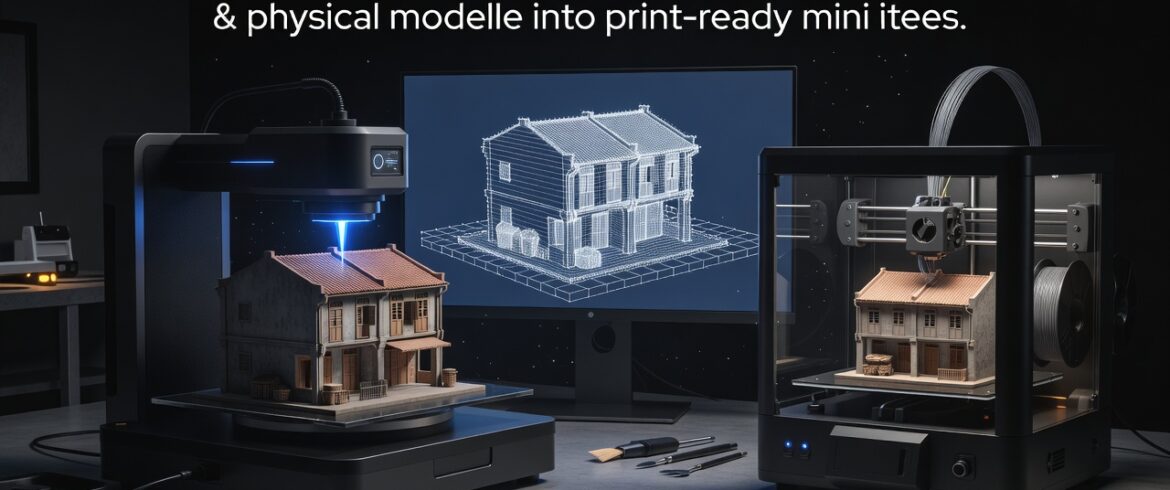
A museum-quality ship model, a damaged kit hull, or a one-off master carved in wood all share the same problem: they exist in the physical world, while your printer only understands geometry. Turning those objects into accurate maritime miniatures is no longer a matter of calipers and guesswork. Professional 3D Scanning Services Malaysia teams capture every sheer line, hawse pipe, and deck camber, then convert the scan into a watertight mesh ready for plastic or metal additive manufacturing.
Whether you need a display piece at 1:700 or a robust engineering mock-up, the path from object to print-ready file follows a disciplined workflow. This guide walks through scanning, modeling, and 3D printing as it is practised for scale ships, harbour craft, and related maritime models—so you know what to ask for, what files to expect, and how assembly actually happens on the bench.
From deck to data: why maritime miniatures demand precision scanning
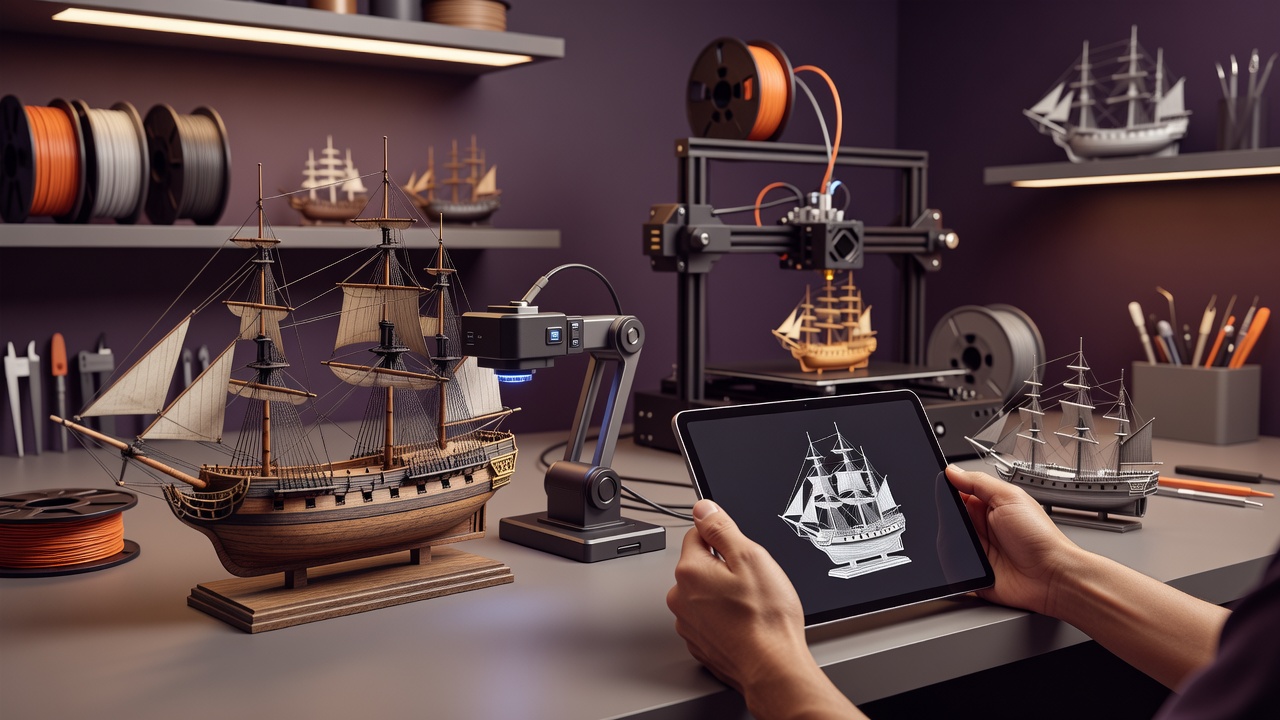
Ships are unforgiving subjects. A hull that is a millimetre out of true at 1:100 becomes a noticeable warp at display distance. Superstructure windows, railing stanchions, and propeller blades sit at very different scales, so a single scan strategy rarely covers everything. That is why studios offering 3D Scanning For 3D Printing treat maritime work as a specialist category, not a generic reverse-engineering job.
Scale, tolerance, and surface finish
Most maritime miniatures sit between 1:350 and 1:72, with museum pieces going finer. At those scales, a 0.2 mm scanning error can erase a door dog or flatten a knuckle. Structured-light and blue-laser scanners used by a serious 3D printing company in Malaysia typically resolve down to tens of microns, which is enough to keep panel lines printable after modest mesh smoothing. Surface finish matters too: glossy paint reflects poorly, while matte primer or a removable scanning spray yields a cleaner point cloud.
If you are comparing a local 3d printing service with a specialist scan bureau, ask what point spacing they guarantee on dark or varnished timber. That single number predicts whether deck planking will survive the trip into resin or metal.
When a handheld scan beats photogrammetry
Photogrammetry is excellent for large, well-textured objects in even light. For a 40 cm destroyer hull with deep recesses under the forecastle, a handheld 3D Scanner Malaysia setup with encoded markers is usually faster and more reliable. The operator walks around the model, filling occlusions as they appear on screen, then merges the turns in software. Photogrammetry still has a place for colour texture maps on display models, but dimensional accuracy for print-ready miniatures almost always starts with an active scanner.
When you compare quotes, ask whether the studio uses a calibrated 3D Scanning Machine Malaysia operators maintain against manufacturer artefacts. Calibration is the quiet difference between a pretty mesh and a hull that still waterlines correctly after printing. An overview of how 3D scanners capture surfaces is available from Wikipedia’s 3D scanning article, which is a useful primer before you brief a studio.
The scanning workflow used by Malaysian studios
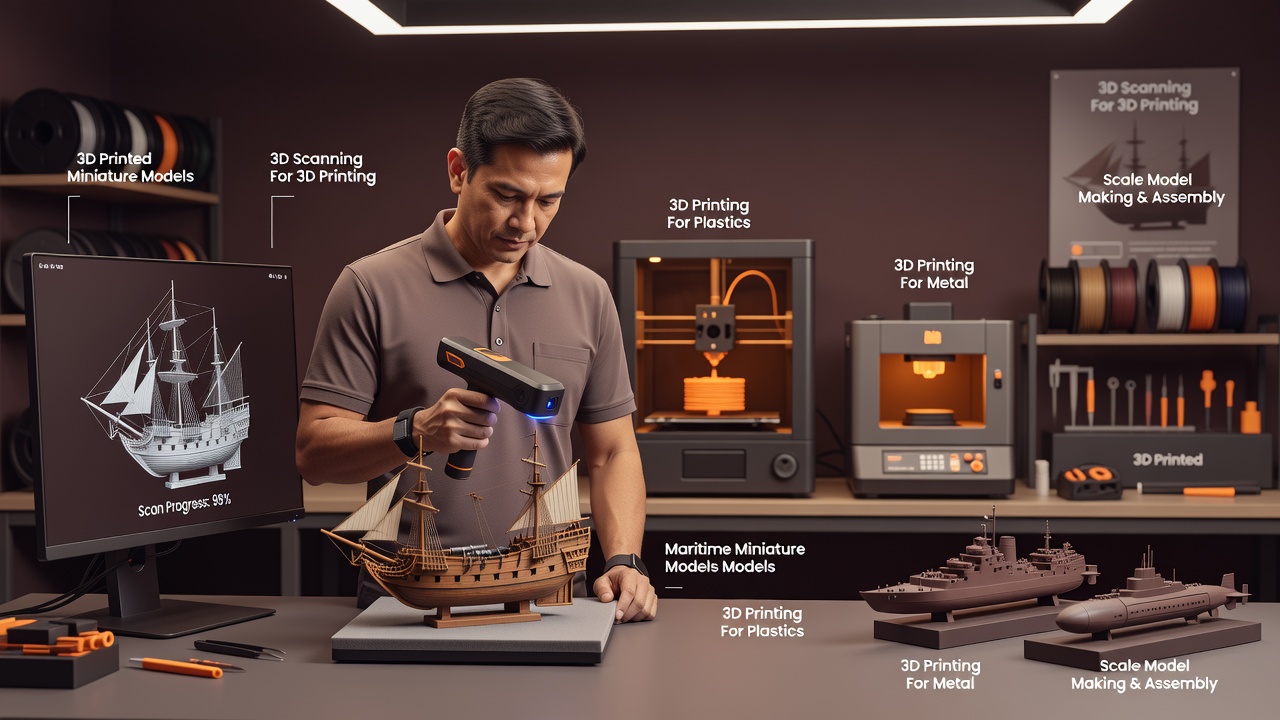
A professional capture session is more methodical than pointing a device at a ship and hoping. Here is the typical sequence used when 3D Scanning And Modeling Malaysia teams prepare files for miniature production—whether you searched for 3D Scanning Near Me or commissioned a specialist 3d printing malaysia studio directly.
Setup, markers, and capture strategy
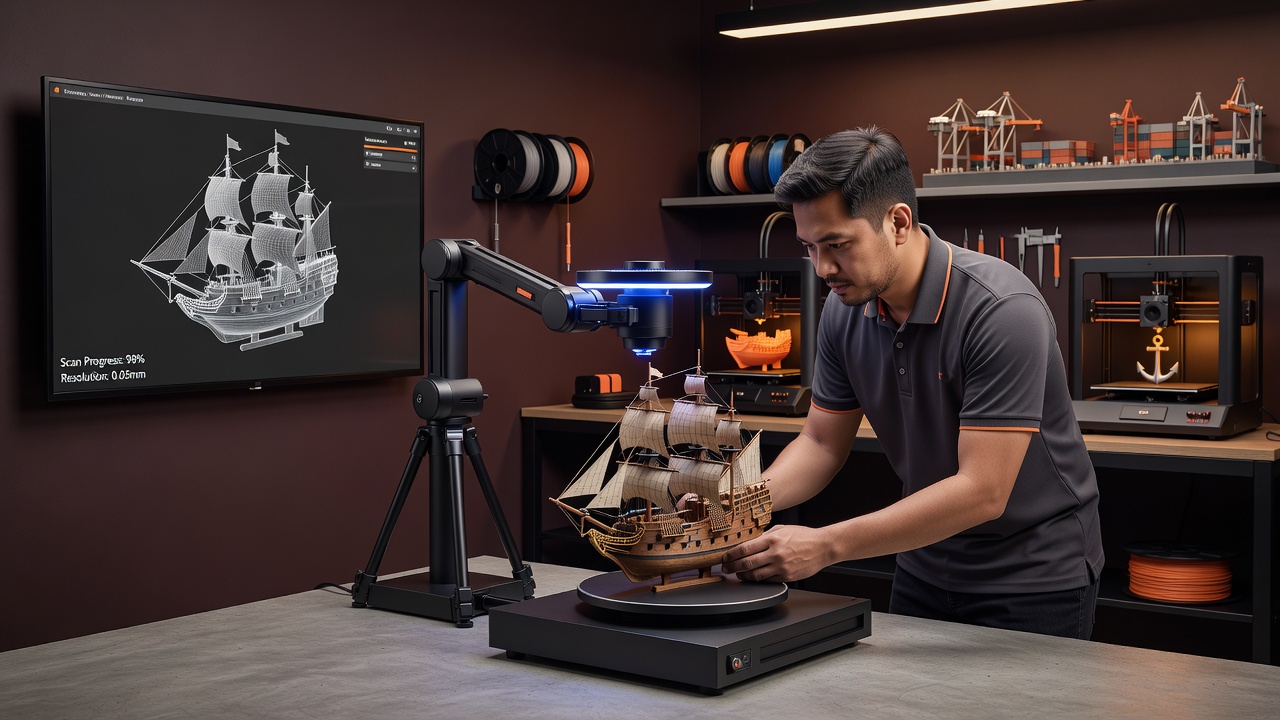
The model is isolated on a turntable or a stable jig. High-contrast markers or coded targets go on the deck and hull so the software can track pose. Glossy or dark surfaces get a thin, washable spray. The operator chooses resolution versus coverage: a coarse pass for the overall hull, then a high-resolution pass for the bridge, guns, and fittings. For a complete 3D Printer Scanner Malaysia workflow, those two densities are later combined so the file is detailed where it counts and light enough to edit.
Aligning scans and filling occlusions
Individual sweeps are aligned to a common coordinate system. Overlaps are averaged; outliers from vibration or shine are deleted. Undercuts—inside a funnel, under a davit, behind a radar mast—are filled with additional angles or, when physically blocked, with controlled hole-filling that follows curvature rather than a flat patch. Experienced technicians never “heal” a missing propeller with a generic blob; they either recapture or model the missing feature from drawings.
Treat reconstructed areas as design decisions, not software accidents. Ask the studio to flag every region that was filled rather than captured, especially on the underwater hull and inside open boats.
Exporting a watertight mesh
The cleaned point cloud is meshed, typically as a high-resolution STL or OBJ. Non-manifold edges, inverted normals, and internal shells are repaired so slicing software will not fail. At this stage you should receive an inspection report: deviation maps against key dimensions, polygon count, and notes on any reconstructed areas. That documentation is part of responsible 3D Scanning Services Malaysia practice, not an optional extra.
Shared vocabulary helps. Additive manufacturing process categories are defined in ISO/ASTM 52900, which keeps a malaysia 3d printing service project aligned from scan to finished part. Using those terms in your brief—vat photopolymerisation for fine resin hulls, powder-bed fusion for metal fittings—reduces expensive misunderstandings.
Modeling, repair, and print preparation
A raw scan is rarely print-ready. It is a dense, sometimes noisy surface that must become a manufacturable solid—or a set of solids that assemble like a kit. This is where 3D Scanning And Modeling Malaysia work meets Scale Model Making & Assembly, and where a generic 3d printing service quote often stops too early.
Retopology and feature preservation
Technicians decimate areas of low curvature (the midships plating) while preserving edge loops around hatches, bollards, and the stem. For parts destined for metal 3D printing Malaysia, wall thickness and unsupported overhangs are checked against the chosen process—typically powder-bed fusion or binder jetting for small fittings. Plastic parts for 3D Printing For Plastics workflows (SLA, LCD, or FDM) can hold finer railings, but they still need a minimum printable thickness so they survive support removal.
If the original object is incomplete, the modeling team rebuilds from plans, photos, or sister-ship references. That hybrid of scan data plus CAD is the heart of maritime miniature production: the hull stays true to the physical master, while missing boats, davits, or radar arrays are modeled to the same scale. Our studio background is built around this mix of capture and reconstruction rather than scan-only delivery.
Supports, orientation, and material choice
Orientation on the build plate decides whether a hull prints without a stepped sheer and whether a mast survives. SLA resins favoured for 3D Printed Miniature Models are oriented to hide layer lines along the length of the hull. 3d metal printing Malaysia jobs for propellers or winches are oriented to keep critical faces in the process’s best resolution axis. A good 3d printing service malaysia team will propose orientation and support strategy before you commit, because re-running a failed metal job is expensive.
File delivery is usually STL plus, on request, STEP for any CAD-rebuilt fittings, and a simple assembly diagram. Ask for a scaled test print of a representative section—bow or bridge—before the full run. That single check catches scale errors that are hard to see on screen and is standard practice when 3D Printing For Metal and resin parts must mate.
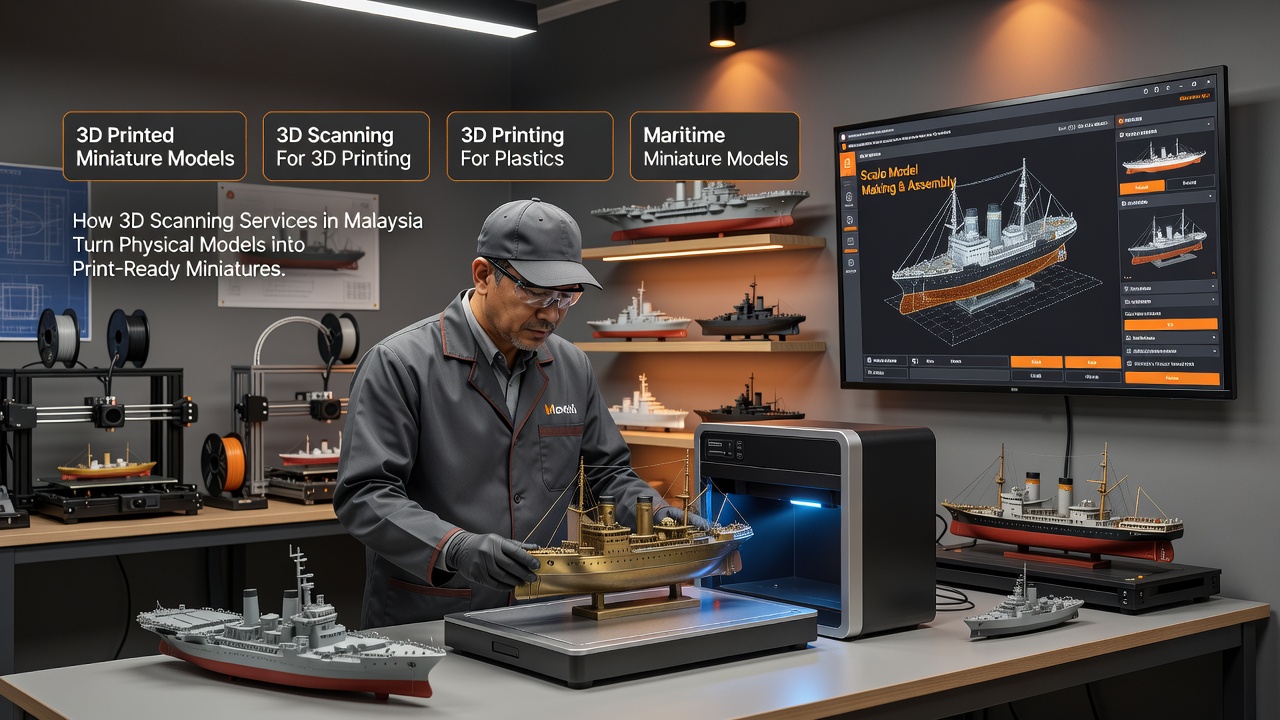
Printing, finishing, and scale model assembly
Once files are locked, production splits by material. Fine-detail resins capture deck texture for display models. Tough engineering plastics suit handling pieces and jigs. Metal 3D printing Malaysia capacity is reserved for small, high-wear or high-realism fittings: anchors, screws, and gun barrels that benefit from density and crisp edges. After printing, supports are removed, surfaces are washed or depowdered, and critical mating faces are lightly dressed so decks sit true on the hull.
Assembly is where Scale Model Making & Assembly skill shows. Alignment pins, designed into the scan-derived parts, replace guesswork. Paint-ready surfaces are left with a consistent tooth; pre-coloured resins or metals may only need a clear coat. If you are collecting or commissioning, specify whether you want a kit of parts, a glued hull-and-superstructure, or a fully finished display model. Each option changes labour more than it changes the scan, and it should be agreed before the first 3D Printing For Plastics build starts.
Practical takeaways for your next miniature project
- Brief the studio with scale, intended material, and whether the scan must match an existing kit or a unique master.
- Request a deviation map and a small test print before approving a full metal or resin run.
- Prefer a dedicated 3D Scanning For 3D Printing workflow over a generic “scan anything” quote when hull fairness matters.
- Plan assembly early: locator pins and split lines should be designed in the mesh, not improvised with filler.
- Combine scan data with CAD for missing fittings rather than over-smoothing the mesh.
If you already have a physical model in Kuala Lumpur, Penang, Johor, or elsewhere in the country, start with a conversation about access, fragility, and target scale. Local 3d printing near me searches often surface general FDM shops; maritime miniatures need the narrower stack of scanning, modeling, and mixed-material printing described here. Look for Maritime Miniature Models experience on the same floor as the scanner—handoffs between unrelated vendors are where scale drift usually appears.
Ready to turn your model into a print-ready miniature?
Bring the object, the drawings, or even a damaged kit. We handle 3D Scanning Services Malaysia capture through 3D Printing For Metal and plastics, then optional assembly. Review our scanning and miniature services, read how the studio works on the about page, or contact us with photos and target scale. We will tell you honestly whether a scan, a hybrid CAD rebuild, or a from-scratch model is the right path—and deliver files that slice cleanly the first time.


Leave A Comment