
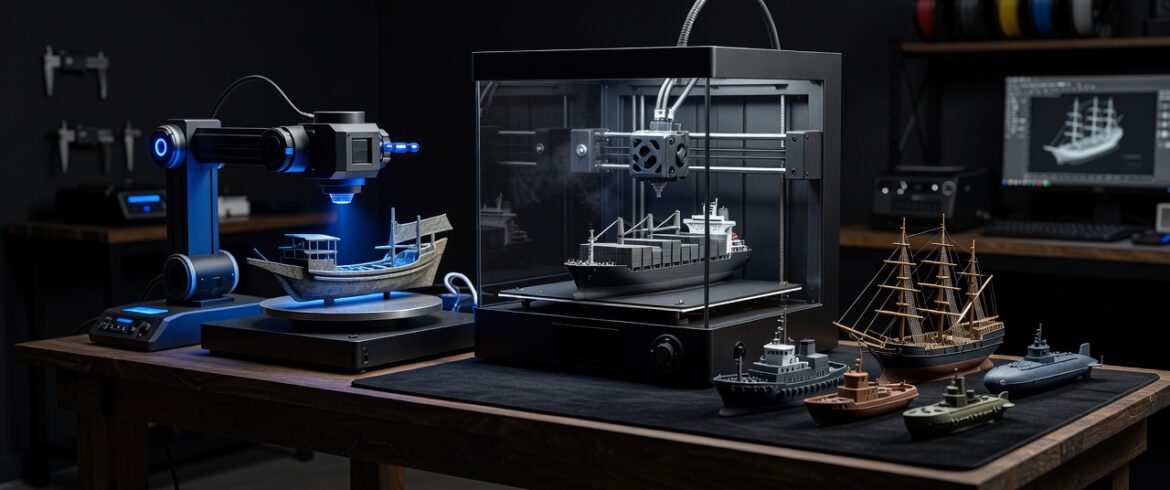

Maritime miniatures · Scan to print
3D Scanning Services Malaysia for Maritime Miniature Models: From Scan to Print
Scanning a real hull, fitting, or propeller turns living geometry into print-ready files. For ship models, that means sharper waterlines, parts that mate on the first try, and assembly that feels more like craft than guesswork.
A maritime miniature succeeds or fails on silhouette. The sheer of a deck, the hollow of a bow, the twist of a propeller blade—these are the details collectors notice before they read a caption. Traditional model-making starts with drawings, then interpolates. That works until a client hands you a half-hull, a spare rudder, or a museum piece that was never fully documented. This is where 3D Scanning Services Malaysia change the workflow: capture the object as it exists, scale it with intent, and send clean files to plastic or metal printers.
Studios that already offer 3D printed miniature models and scale assembly can now treat scanning as the first production step rather than a specialist add-on. The result is not a novelty scan. It is a production file set that shortens fitting time and raises the fidelity of every subsequent print.
Why scan real hulls instead of modelling from scratch
Ship lines look simple on paper. In the shop they are not. Planked hulls hog and sag. Repair patches sit proud of original plating. Deck camber varies from station to station. A CAD artist working only from plans will produce a handsome generic vessel. A scanner working from the artefact produces that vessel.
For maritime miniatures this distinction matters in three practical ways:
- Authentic curvature. Laser and structured-light scans record compound curves without forcing them into lofted approximations.
- As-built truth. Damage, later fittings, and workshop repairs become part of the model story when the brief calls for a specific ship at a specific date.
- Repeatable scale. Once the mesh is cleaned, the same hull can be printed at 1:350, 1:200, or a display-case size without redrawing stations.
Clients across Malaysia—from private collectors to corporate gifts and museum outreach—increasingly ask for this as-built accuracy. A local 3D printing company in Malaysia that pairs scanning with print and assembly can answer that brief without shipping the artefact overseas.
The scan-to-print workflow for maritime miniatures
A useful scan is not a pretty point cloud. It is a mesh that a printer can trust. The sequence below is the path from deck to desk.
1. Capture the hull and fittings
Work starts with the object: a half-hull plaque, a spare bronze propeller, a winch, a davit, or a complete small craft if space allows. Structured-light or handheld laser scanning is typical for glossy paint and mixed materials; photogrammetry can supplement large decks when markers and lighting are controlled. Dark hull paint, chrome fittings, and wet-looking varnish all need surface treatment or exposure adjustment so the scanner does not lose edges.
Fittings are scanned separately whenever possible. A propeller that is still on the shaft will hide blade roots. A binnacle scanned in isolation prints cleaner than one extracted from a cluttered deck mesh. This is the same discipline used in industrial reverse engineering, and it is why a dedicated 3D Scanner Malaysia setup outperforms a casual phone capture.
2. Clean, align, and scale the mesh
Raw scans contain noise, overlap, and holes under overhangs. Alignment stitches multiple passes into one watertight body. Decimation reduces file weight without erasing plank seams or rivet heads that will still read at scale. Scaling is a design decision, not an afterthought: wall thickness, minimum feature size, and printer resolution must be checked against the chosen scale before anyone hits print.
At this stage the file becomes useful for both display models and working assemblies. Locating pins, bulkhead slots, and mast steps can be added as CAD features on top of the scanned hull rather than guessed from a drawing. That hybrid—scan for form, CAD for function—is the backbone of modern 3D Scanning And Modeling Malaysia work for miniatures.
3. Prepare print-ready files
Print-ready means more than STL export. Orientations are chosen so hull sheer does not stair-step. Supports are planned so they do not scar the waterline. Thin railings may be thickened or printed as separate sprues. Large hulls are split along natural seams—keel, deck edge, superstructure break—so parts nest on the build plate and assemble with a glue line that looks like a plate joint.
Quality systems for additive manufacturing, including guidance published by NIST on additive manufacturing, emphasise process control from digital file to finished part. Miniature work is smaller, but the same logic applies: a mesh that is not manifold will fail in resin or metal as surely as it fails in industrial production.
Plastics, metals, and hybrid maritime assemblies
Not every part belongs on the same printer. A well-planned maritime miniature uses material where it earns its keep.
3D printing for plastics remains the workhorse for hulls, decks, and superstructure. Fine-detail resin captures portholes, plank caulking, and funnel grilles. Tough polymers suit larger display hulls that must travel or sit under lights without warping. Colour and primer strategy should be decided before print: a scan-derived hull often needs a uniform surface so paint reads as steel or timber rather than as layer texture.
Metal 3D printing Malaysia is the right call for propellers, anchors, bollards, and small fittings that should have weight and a cold sheen. Bronze-look and stainless-feel parts change how a model sits in the hand. Because metal processes have different minimum wall thicknesses than resin, the scanned fitting is often retopologised: keep the silhouette, thicken the stem, hollow the body if mass would unbalance the ship.
Hybrid kits are where assembly time collapses. Plastic hull plus metal running gear plus a handful of scanned masters for repeating items (cleats, fairleads, porthole rings) gives the look of a fully fitted ship without hand-carving every duplicate. That mix is a core offering of a full-service 3d printing service malaysia studio that also handles scale model making and assembly.
“Scan the unique. Print the repeatable. Assemble to the waterline.” That rule keeps maritime miniatures detailed without turning every project into a one-off sculpture.
Faster assembly with parts that already fit
Assembly is where scanned files pay for themselves. Traditional kits fight tolerance stack: a deck that is 0.4 mm long, a bulkhead that is 0.3 mm thick, a mast step that drifted in the drawing. Scanned mating faces share the same coordinate system. If the cabin sat on that deck in the real world, it can sit on that deck in the model—provided scale and shrinkage are accounted for in the print profile.
Practical assembly gains include:
- Keyed joints. Tabs and sockets derived from scanned bulkheads reduce clamps and filler.
- Correct rake and camber. Masts and funnels lean as the original did, not as a plan view suggested.
- Fewer test prints. Fit issues show up in mesh review, not after a wasted overnight job.
- Paint-ready seams. Splits follow plate lines so glue joints disappear under primer.
For clients searching “3D scanning near me” or “3D printing near me,” the hidden value is this reduction in rework. A scan that looks impressive on screen is only half the service. A scan that becomes a hull, a set of fittings, and a dry-fit that closes on the first afternoon is the full service.
Practical takeaways for model makers and commissioners
Whether you are briefing a studio or preparing your own artefact for a scan session, these points keep the project on course:
- Bring the real part when you can. A propeller in the hand beats a catalogue photo. Even a damaged fitting is better than a guess.
- Decide scale before you freeze wall thickness. 1:700 railings and 1:72 railings are different engineering problems.
- Separate show surfaces from glue surfaces. Mark where the model will be joined so the scan team can preserve those faces.
- Match process to part. Resin for fine superstructure, durable polymer for large hulls, metal for weight-bearing or display fittings.
- Plan paint and primer as part of the file. Scanned texture that is too aggressive will fight a steel or timber finish.
- Ask for assembly, not only files. Scale model making and assembly is where scanned accuracy becomes a finished ship.
Standards for 3D imaging and coordinate metrology, including those maintained by ISO technical committees on dimensional metrology, exist because capture quality is measurable. You do not need a laboratory certificate for a display miniature, but you should still ask how the studio checks scale, alignment, and watertight meshes before printing.
From scan to ship: work with a local print partner
Malaysia’s model and making community now has a complete path in-country: 3D scanning for 3D printing, maritime miniature models, plastics, metals, and final assembly under one brief. You do not need to reverse-engineer a hull in isolation, then hunt for a 3D printing service that can hold the waterline, then another shop that can set masts. A coordinated scan-to-print sequence keeps the geometry honest from the first pass of the scanner to the last coat of paint.
If you have a hull, a fitting, or a reference vessel that deserves a miniature with real lines—not approximated ones—bring the object and the scale. The scan creates the digital master. The printers, plastic and metal, create the parts. Assembly puts the ship on its stand with less filler, fewer test fits, and a silhouette that still belongs to the original.
Ready to scan a hull and print the model?
Share photos of the artefact, your target scale, and whether you need files only or a fully assembled maritime miniature. We will outline capture, print materials, and assembly from one local workflow.
Request a scan-to-print brief
View scanning and printing services


Leave A Comment